

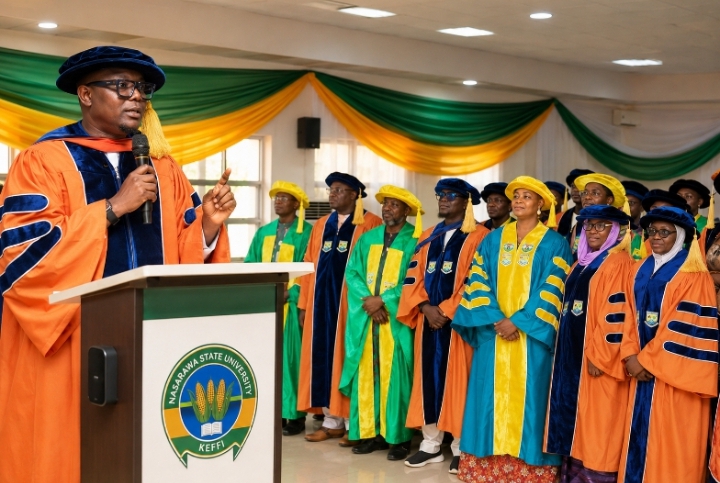
The Assembly Hall of Nasarawa State University, Keffi (NSUK), was filled to capacity on Wednesday as academics, traditional rulers, government officials, financial experts, and students gathered to witness the university’s 62nd Inaugural Lecture a ceremony that turned into a compelling conversation about Nigeria’s economic direction and the urgent need to rethink how the country finances its own development.
At the centre of that conversation was Professor Abdul Adamu of the Department of Business Administration, whose lecture, titled “Reimagining Nigeria’s Financial System in Flux: The Savings-First Investment Paradigm,” made a persuasive case for placing domestic savings at the heart of Nigeria’s economic revival.
Declaring the event open on behalf of the Vice-Chancellor, Professor Sa’adatu Hassan Liman, the Deputy Vice-Chancellor (Administration), Professor Halima Aliyu Doma-Kutigi, set the tone for what would prove to be a timely and penetrating intellectual engagement.
She noted that rising inflation, exchange-rate instability, and deepening economic uncertainties continue to undermine sustainable growth and long-term investment, and argued that the “savings-first” philosophy offered a practical and home-grown pathway to economic resilience.
Professor Kutigi urged households across Nigeria to embrace a culture of saving before spending.
She challenged financial institutions to develop products that genuinely encourage long-term financial planning, and called on policymakers to create an enabling environment capable of restoring public confidence and driving capital formation.
She also commended Professor Adamu, who currently serves as Director of Quality Assurance at the institution, for his outstanding contributions to scholarship and national development through research and policy engagement.
When the floor was eventually handed to the inaugural lecturer, Professor Adamu Abdul delivered a searching analysis of the structural, behavioural, and volatility-driven forces shaping Nigeria’s financial environment.
He argued that financial instability had ceased to be a temporary or cyclical phenomenon and had instead become a recurring and defining feature of the country’s economic reality one that demanded a fundamental shift in thinking.
Among the key challenges he identified were chronically low domestic savings rates, despite Nigeria’s wealth of natural and human resources; the country’s excessive dependence on foreign capital; and policy frameworks that have repeatedly failed to anticipate or withstand market turbulence.
These, he contended, are not incidental weaknesses but structural failures that have made Nigeria vulnerable to external shocks and deprived it of the financial autonomy needed to chart a stable developmental course.
Drawing on decades of empirical research, Professor Adamu proposed a transformative response what he termed the “Savings-First Investment Paradigm.”
At its core, the model repositions domestic savings as the primary engine of economic development and capital formation.
Sustainable growth, he argued, can only be achieved when nations generate capital from within, rather than remaining perennially dependent on external financing with its attendant conditions and vulnerabilities.
He outlined a series of pillars on which such a paradigm must rest: aggressive mobilisation of domestic savings; strategic and targeted public investment; enhanced institutional support for innovation and Small and Medium Enterprises (SMEs); and the deployment of digital technologies to expand financial inclusion and promote automated savings practices.
He also advocated for stronger investor protection mechanisms, more resilient financial institutions, and indigenous economic policies rooted in evidence based planning and long-term national interest rather than short-term political calculations.
The lecture drew warm responses from several distinguished personalities who delivered goodwill messages.
Among them were the Dean of the Faculty of Administration, Professor A. D. Zubairu; the Vice-Chancellor of Prince Abubakar Audu University, Ayingba, Professor Salisu Ogbo Usman; the Director of NSUK’s Institute of Capital Markets Studies and President of the Capital Market Academics of Nigeria (CMAN), Professor Uche J. Uwaleke; the Ejeh of Ankpa, Alhaji Abubakar Sadiq Ahmed Yakubu II; and a representative of family and friends, Dr. Joel Haruna.
Collectively, they praised Professor Adamu’s distinguished academic career, his record of mentorship, and his contributions to the development of Nigeria’s capital market sector, describing him as a scholar whose work continues to shape the next generation of researchers and policymakers.
In recognition of his achievements, the University Management presented Professor Adamu with a plaque and certificate to mark his delivery of the 62nd Inaugural Lecture.
The award was conferred by Professor Halima Doma-Kutigi on behalf of the Vice-Chancellor.
The ceremony concluded with group photographs and celebrations, reaffirming NSUK’s commitment to advancing intellectual discourse and generating practical, home grown solutions to the national and global challenges of the day.
